The devastating event of ethnic cleansing in Yugoslavia showed that the Universal Declaration of Human Rights no longer has much effect over the world and human rights. The declaration was created to ensure the safe-keeping of human rights in the different counties of the UN. It is used for peace and safety, and is, unfortunately, dangerously violated. The war in Yugoslavia is a prime example. First of all, the rights of the citizens of former Yugoslavia were heavily violated by Serbia. When Croatia and Slovenia declared their independence and succeeded from Yugoslavia, the Serbs violated the right to make own decisions by sending the Yugoslav People's Army into Croatia and refusing to allow the break off. This act severely crushed the rights of the citizens living in Croatia. By denying them the right to form their own self-governing nation, the Serbs began their rein as dictators of Yugoslavia, keeping the other ethnic minorities hostage from their own freedom. This is very well related to the Holocaust. By denying the Muslims and Bosnians of their right to life, just as Hitler did with the Jews, Milosevic unjustly oppressed the Muslim population and murdered them by the thousands, as Hitler did with the Jews.
The idea of humanism was completely disregarded in the killings in Yugoslavia. Humanism is the belief that every human being matters and is important to society. The ethnic cleaning in Yugoslavia renounces such a belief. By massacring thousands of Muslim boys and men, Milosevic and his followers were operating on the belief that all Muslims and people against Serbian domination were not worth taking up space in the Serbian domain and should not deserve to live. These people were enemies to the state and were to be destroyed, as to not bring down their current nation, at the time being Yugoslavia. These people did not need to be killed, but by believe that they were not worth their own lives, the Serb government carried out many attacks on the Muslim population, completely failing to follow the concept of humanism.
The government of Serbia is completely to blame or what happened to the former Yugoslavia. After the break-up of the Soviet Union, the government of Serbia was free to carry out its plan to rule Yugoslavia. However, after the succession of Slovenia and Croatia, its plans were changed. Serbia carried out attacks against Muslims, Croats, and later Bosnians as they tried to hang on to what they believed was their country to rule. I am absolutely disgusted that civilized people can decide that they want to eliminate another group of people from their land for basically no reason. I was amazed when Hitler did it and I’m still amazed now. The government had no right to do what they did, especially after a nation declares their independence. They are then breaking the laws of national sovereignty AND human rights. The Serb government is denying their fellow Yugoslavians the right to live as they wish as well as the right to live at all.
My heart goes out to all of the ethnic minorities living in Yugoslavia at the time of the ethnic cleansing. They faced the worst hardships imaginable. Just the feeling of knowing that someone stronger than you wants you exterminated is enough to drive me insane. The people who were affected by the Serbian terror are truly some of the strongest alive today. To live life each day not knowing your fate had to be torture. The boys and men would worry if they were to be tortured and murdered and the women and girls had to worry how many times they would be raped the next day. The ethnic minorities of Yugoslavia defiantly did not deserve any of the torture and suffering they acquired during the wars in the Yugoslavia and should have every right to develop a self-governing nation that fits their needs, and not the needs of their stronger and more powerful neighbors. The whole formation of Yugoslavia was a mistake and has cost many people their lives for nothing.
The involvement of the United Nations was not very helpful or successful in the efforts to end the killings in Yugoslavia. The United Nations Protective Force was sent in to maintain peace between ethnic groups, but was not allowed to fire at other groups using violence. In result, Serbia and its enemies just brushed off the UN and continued its violence as strong as ever. The only somewhat useful UN involvement was the setting up of the International Criminal Tribunal of Yugoslavia in the Netherlands. This system is currently in the process of trying criminals against humanity and is expected to finish its persecutions by 2010.
Monday, June 11, 2007

Ethnic Cleansing in the Former Yugoslavia
Background
Yugoslavia had essentially been a federation of six republics, Slovenia, Croatia, Bosnia and Herzegovina, Serbia, Montenegro, and Macedonia; formed after World War I in an effort to unify all the Slavs. The borders dividing the republics had been drawn by the great European powers in old treaties, giving way to later disputes. Bosnia and Herzegovina was created as an ethnically mixed state, with no clear majority between Muslims and Serbs, and Croats within its borders. All the ethnic groups followed different religions and cultures, and tension and hatred brewed among the federation for decades, but had been suppressed under the rule of dictator Josip Broz Tito and his communist regime. After the dissolution of the USSR, Yugoslavia was left with an unstable government to hold them together, as individual groups came to power. The republics wanted their independence from the federation, but the most dominant group, the Serbians, wanted to keep the republic together and control the government and gain power. The subject of Bosnia-Herzegovina was especially questionable, as the population of Muslims and Serbs gean to pull apart and opposing leaders ruptured the borders. The Bosniaks (Bosnian Muslims) wanted desperately to seize this opportunity for independence, the Serbians chose violence in an attempt to discourage them from seceding from the federation.
Declaring Independence
With the different ethnicities declaring their independence Yugoslavia was bound to fall apart. Tension developed between neighboring territories as they fought for their sovereignty. Chaos emerged from the different groups and the fighting began. The different ethnicities couldn’t be satisfied living as one country mainly because of conflicting and competing nationalisms. This can be blamed on the structure of the unified state.
On June 25, 1991 Slovenia was the first to break free from Yugoslavia by declaring its independence and taking over border posts. Unlike the other ethnicities Slovenia left without much trouble. It became a successful republic and was recognized as an independent state by the United Nations and European Community in 1992.
The situation was unfortunately very different for Croatia. In 1990, Croatia elected nationalist Franjo Tudjman as its leader in a non-communist government. They declared their independence the same day as Slovenia and fighting broke out immediately between the JNA, Serbs, and Croat forces. The Serb forces used their military superiority to claim large chunks of Croatia including Krajina, Western Slavonia, Zadar, and Knin. The most damage occurred in Knin; a major transport hub. The European Community had made an attempt to negotiate peace, but due to its failure The United Nations had to issue a truce between the two sides. This truce was a failure and left many Croatians as refugees. There were also reports of homes being burned, looted, and many other horrible crimes against civilians. Another Croatian effort was made for their freedom in 1995 when Croatian forces launched a massive offensive attack against the Krajina Serbs. This led to 14,000 Serb Civilians being killed and about 30,000 Serb refugees. This attack focused on killing civilians, burning Serb homes, looting Serb property, and killing the elderly.
The wars that occurred in Bosnia-Hercegovina are most famous and recognizable for brutality and horrific campaigns. Bosnia was full of many different ethnicities including Serbs, Croats, and Bosnian Muslims. All of these ethnicities held and equal amount of Bosnia which led to many problems when Slobodan Milosevic came to power. Milosevic talked of a “Greater Serbia” which included much of Croatia, Bosnia, and Kosovo. Milosevic’s famous line was, "Where ever there is a Serb, there is Serbia." The main problem in Bosnia was that there was no clear division between ethnicities. No single group held absolute majority over the country. In order to define different communities, some regions would have to be ethnically cleansed.
In March 1992 Bosnia declared its Independence from Yugoslavia. This immediately sparked the Bosnian Serbs to create the Republika Srpska (Serb Republic) with the idea of creating an ethnically pure Serbian enclave in northern and eastern Bosnia. The Croats followed their footsteps with the founding of the Croatian Community. Fighting grew between Muslim forces and Bosnian Croat forces until 1994 when they agreed to a cease-fire and founded the joint Federation of Bosnia-Herzegovina. These two groups teamed up to fight against the Serb forces.
The heaviest fighting in the entire war was between the Serbs and Bosnian Muslims. The Serbs wanted an ethnically pure Republika Srpska but large Muslim minorities made it difficult. To solve this problem, the leader of the Republika Srpska, General Ratko Mladic, began a policy of ethnic cleansing against Muslims in “Serb lands”. They sent Muslims to concentration camps where massive counts of rape and sexual assault against Muslim women and girls and massive executions of Muslim men and boys occurred. In July of 1995 more than 7000 Muslims were killed by Serb forces under the command of Mladic in Srebrenica where looting, torture, and relocation occurred. The brutality was shocking to the West.
What Went Wrong?
As Yugoslavia began to crumble apart, lines were drawn and standards were set by ultra-nationalist leaders for the new republics. The conflicts were embodied by the fact that although the ethnic groups wanted independence, they were so interspersed all throughout the federation that it was impossible to draw new lines and create independent republics without running into opposing groups. In Croatia in 1990, the anti-communist Franjo Tudjman, who had fought with the partisans against the Nazis during World War II, came to power and created the Croatian Democratic Union (HDZ) party, taking Croatian nationalism to the extremeties. In turn, in Serbia came under the rule of Slobodan Milošević, who favored Yugoslav unity. In general, Slovenia and Croatia elected leaders oriented towards independence, and Serbia and Montenegro elected leaders oriented towards keeping Yugoslavia unified.
In Croatia, there was growing advocacy for "Croatian state and historical rights," leading to the stripping of national and constitutional rights of the Serbs in Croatia and demoting them to a national minority. In response, the Serbs created autonomous areas in Croatia like Krajina. As conflicts escalated, the Yugoslav People's Army (JNA), dominated by the Serbs, declared a state of a emergency that would allow the army to take control of the country, but naturally, there was opposition in the voting, and the anti-Serbs refused to comply. Croatia began smuggling in arms (due to the arms embargo placed on Yugoslavia) , mainly from Hungary, and plotting against the JNA, who had announced their seccession from Croatia. The Croatian Serb rebels had the upper hand, as they had the support of the JNA.
Massacres broke out between the ethnic Croatians and the ethnic Serbs in 1991, and reached Bosnia in 1992, when the siege of Sarajevo broke out. In Sarajevo, there was bitter fighting between the Bosnian government who strived for independence, and the JNA and Bosnian Serbs. The Bosnian government demanded the JNA leave their territory, but the Serbs surrounded the Bosnians and began a siege. The Serbs were better armed, but the Bosnians within the city outnumbered the Serbs. The warring went literally neighborhood-by-neighborhood, with Serb snipers taking out the Bosnians rapid-fire, and destroyed hundreds of buildings with tanks and heavy arms. Bosnians were massacred by mortar shells, the vast majority of them civilians, while Serbs were shot and killed by the Bosnians, and talks of genocidal actions against the Serbs in Sarajevo have been disputed.
In addition, the Srebrenica Massacre of approximately 8,000 Bosniak males took place in July 1995, by the Bosnian Serb Army of Republika Srpska (VRS); the largest mass murder in Europe since World War II. In a confirmed act of genocide, the VRS targeted to eliminate the 40,000 Bosniaks living in the Bosnian town of Srebrenica, and subsequently stripped all the male Muslim prisoners, regardless of age or civilian status; of their worldly rights, belongings, and even identificiation, and murdered them simply on the basis of their religion.
Quite obviously, the whole of Yugoslavia had serious issues in regards to the Universal Declaration of Human Rights. Though not nearly taken to the catastophic extent of the Holocaust, serious measures were taken against civilians of all ethnicities, but mainly the Serbs and the JNA versus Slonevia, Croatia, and Bosnia and Herzegovina. In Croatia, in efforts to drive out the Serbs, they stripped them of their rights, clearly not seeing them as equal persons and subjecting them to exile and unjustified punishment. Throughout the federation, there were no fair trials or questions asked, people were just forced out of their homes or killed either by the enemy, or their own people, should they not comply to their people's demands against the enemy. The clashing of nationalisms among nations led to no agreement towards freedom of nationality, religion, or conscience; if you were a Serb, you were an enemy of everyone else, if you were a Bosniak, you were ardently prejudiced against the Serbs with deep, prominent hatred. There was undoubtedly large amounts of discrimination occurring, which easily led to killings, and no protection for civilians. Though no formal laws were issued against the opposing ethnic groups like in the Nuremberg Laws, the leaders of the republics commanded their people against the opposing peoples, and nationalists executed the non-believers in the name of their leaders, anyways.
The Height and End of Ethnic Cleansing in Yugoslavia
The end of the ethnic cleansing of Yugoslavia was signaled by the United Nations. The UN Protective Force (UNPROFOR) had entered the conflict as a supervisor to maintain the cease-fire between the Serbs, Croats, and Bosnians. However, the UNPROFOR was forbidden to contribute to the violence, meaning they were forbidden to fire a shot. They were forced to stand by as thousands of Muslim civilians were slaughtered by the Serbs. Therefore, the UN tried to place an arms embargo on those involved with the conflict, meaning the Serbs and Muslims mostly. However, this allowed the well-armed Serbs to fight even better against the poor-armed Muslims. This led to Serbia taking two-thirds of the Bosnian territory. Fortunatly, major events led to the decline of Serbian power. In 1994, Croatia and the Muslims of Yugoslavia allied themselves against Serbia. This tipped the scale against the Serbs. To aid his troops that were desperatly needed in Serbia, the Serb leader Slobodan Milosevic cut aid to his forces in Bosnia, leading to the weakening Serbian hold on Bosnia. As the Serbs continued to lose power and territory, there were many peace attempts. Serbia and Croatia ended up coming to the agreement that Bosnia was to be divided up between the two nations of Serbia and Croatia. This was formally settled when the Dayton Peace Accords were written in 1995. This document gave Croatia 51% of the Bosnian land and Serbia 49%. the Croatian half became a Muslim-Croatian federation, while the Serbian side became the Serbian Republika Srpska. However, each new state gave no true independence to Bosnians. Serbia and Croatia forced the inhabitants of their states to act and live as if they were Serbians or Croatians. While the killing and fighting was stopped in the former Yugoslavia, there has been no true peace between the ethnic groups living there. As for the leaders of the ethnic groups, none were persecuted for their actions in the war. While there is an ongoing Criminal Tribune taking place, no judgements have been made. In fact, Milosevic was never justified for his crimes against the Muslim population and died in March, 2006 without punishment in his cell in the Netherlands. All indictments were finished in 2004, and all trials are said to be completed by 2009 or 2010. The maximum sentence is going to be life imprisonment for those found guilty of the crimes against them.
by Theo Koboski, Steve Loukellis, Tori Safner, Susan Orsini
Period 5
Yugoslavia had essentially been a federation of six republics, Slovenia, Croatia, Bosnia and Herzegovina, Serbia, Montenegro, and Macedonia; formed after World War I in an effort to unify all the Slavs. The borders dividing the republics had been drawn by the great European powers in old treaties, giving way to later disputes. Bosnia and Herzegovina was created as an ethnically mixed state, with no clear majority between Muslims and Serbs, and Croats within its borders. All the ethnic groups followed different religions and cultures, and tension and hatred brewed among the federation for decades, but had been suppressed under the rule of dictator Josip Broz Tito and his communist regime. After the dissolution of the USSR, Yugoslavia was left with an unstable government to hold them together, as individual groups came to power. The republics wanted their independence from the federation, but the most dominant group, the Serbians, wanted to keep the republic together and control the government and gain power. The subject of Bosnia-Herzegovina was especially questionable, as the population of Muslims and Serbs gean to pull apart and opposing leaders ruptured the borders. The Bosniaks (Bosnian Muslims) wanted desperately to seize this opportunity for independence, the Serbians chose violence in an attempt to discourage them from seceding from the federation.
Declaring Independence
With the different ethnicities declaring their independence Yugoslavia was bound to fall apart. Tension developed between neighboring territories as they fought for their sovereignty. Chaos emerged from the different groups and the fighting began. The different ethnicities couldn’t be satisfied living as one country mainly because of conflicting and competing nationalisms. This can be blamed on the structure of the unified state.
On June 25, 1991 Slovenia was the first to break free from Yugoslavia by declaring its independence and taking over border posts. Unlike the other ethnicities Slovenia left without much trouble. It became a successful republic and was recognized as an independent state by the United Nations and European Community in 1992.
The situation was unfortunately very different for Croatia. In 1990, Croatia elected nationalist Franjo Tudjman as its leader in a non-communist government. They declared their independence the same day as Slovenia and fighting broke out immediately between the JNA, Serbs, and Croat forces. The Serb forces used their military superiority to claim large chunks of Croatia including Krajina, Western Slavonia, Zadar, and Knin. The most damage occurred in Knin; a major transport hub. The European Community had made an attempt to negotiate peace, but due to its failure The United Nations had to issue a truce between the two sides. This truce was a failure and left many Croatians as refugees. There were also reports of homes being burned, looted, and many other horrible crimes against civilians. Another Croatian effort was made for their freedom in 1995 when Croatian forces launched a massive offensive attack against the Krajina Serbs. This led to 14,000 Serb Civilians being killed and about 30,000 Serb refugees. This attack focused on killing civilians, burning Serb homes, looting Serb property, and killing the elderly.
The wars that occurred in Bosnia-Hercegovina are most famous and recognizable for brutality and horrific campaigns. Bosnia was full of many different ethnicities including Serbs, Croats, and Bosnian Muslims. All of these ethnicities held and equal amount of Bosnia which led to many problems when Slobodan Milosevic came to power. Milosevic talked of a “Greater Serbia” which included much of Croatia, Bosnia, and Kosovo. Milosevic’s famous line was, "Where ever there is a Serb, there is Serbia." The main problem in Bosnia was that there was no clear division between ethnicities. No single group held absolute majority over the country. In order to define different communities, some regions would have to be ethnically cleansed.
In March 1992 Bosnia declared its Independence from Yugoslavia. This immediately sparked the Bosnian Serbs to create the Republika Srpska (Serb Republic) with the idea of creating an ethnically pure Serbian enclave in northern and eastern Bosnia. The Croats followed their footsteps with the founding of the Croatian Community. Fighting grew between Muslim forces and Bosnian Croat forces until 1994 when they agreed to a cease-fire and founded the joint Federation of Bosnia-Herzegovina. These two groups teamed up to fight against the Serb forces.
The heaviest fighting in the entire war was between the Serbs and Bosnian Muslims. The Serbs wanted an ethnically pure Republika Srpska but large Muslim minorities made it difficult. To solve this problem, the leader of the Republika Srpska, General Ratko Mladic, began a policy of ethnic cleansing against Muslims in “Serb lands”. They sent Muslims to concentration camps where massive counts of rape and sexual assault against Muslim women and girls and massive executions of Muslim men and boys occurred. In July of 1995 more than 7000 Muslims were killed by Serb forces under the command of Mladic in Srebrenica where looting, torture, and relocation occurred. The brutality was shocking to the West.
What Went Wrong?
As Yugoslavia began to crumble apart, lines were drawn and standards were set by ultra-nationalist leaders for the new republics. The conflicts were embodied by the fact that although the ethnic groups wanted independence, they were so interspersed all throughout the federation that it was impossible to draw new lines and create independent republics without running into opposing groups. In Croatia in 1990, the anti-communist Franjo Tudjman, who had fought with the partisans against the Nazis during World War II, came to power and created the Croatian Democratic Union (HDZ) party, taking Croatian nationalism to the extremeties. In turn, in Serbia came under the rule of Slobodan Milošević, who favored Yugoslav unity. In general, Slovenia and Croatia elected leaders oriented towards independence, and Serbia and Montenegro elected leaders oriented towards keeping Yugoslavia unified.
In Croatia, there was growing advocacy for "Croatian state and historical rights," leading to the stripping of national and constitutional rights of the Serbs in Croatia and demoting them to a national minority. In response, the Serbs created autonomous areas in Croatia like Krajina. As conflicts escalated, the Yugoslav People's Army (JNA), dominated by the Serbs, declared a state of a emergency that would allow the army to take control of the country, but naturally, there was opposition in the voting, and the anti-Serbs refused to comply. Croatia began smuggling in arms (due to the arms embargo placed on Yugoslavia) , mainly from Hungary, and plotting against the JNA, who had announced their seccession from Croatia. The Croatian Serb rebels had the upper hand, as they had the support of the JNA.
Massacres broke out between the ethnic Croatians and the ethnic Serbs in 1991, and reached Bosnia in 1992, when the siege of Sarajevo broke out. In Sarajevo, there was bitter fighting between the Bosnian government who strived for independence, and the JNA and Bosnian Serbs. The Bosnian government demanded the JNA leave their territory, but the Serbs surrounded the Bosnians and began a siege. The Serbs were better armed, but the Bosnians within the city outnumbered the Serbs. The warring went literally neighborhood-by-neighborhood, with Serb snipers taking out the Bosnians rapid-fire, and destroyed hundreds of buildings with tanks and heavy arms. Bosnians were massacred by mortar shells, the vast majority of them civilians, while Serbs were shot and killed by the Bosnians, and talks of genocidal actions against the Serbs in Sarajevo have been disputed.
In addition, the Srebrenica Massacre of approximately 8,000 Bosniak males took place in July 1995, by the Bosnian Serb Army of Republika Srpska (VRS); the largest mass murder in Europe since World War II. In a confirmed act of genocide, the VRS targeted to eliminate the 40,000 Bosniaks living in the Bosnian town of Srebrenica, and subsequently stripped all the male Muslim prisoners, regardless of age or civilian status; of their worldly rights, belongings, and even identificiation, and murdered them simply on the basis of their religion.
Quite obviously, the whole of Yugoslavia had serious issues in regards to the Universal Declaration of Human Rights. Though not nearly taken to the catastophic extent of the Holocaust, serious measures were taken against civilians of all ethnicities, but mainly the Serbs and the JNA versus Slonevia, Croatia, and Bosnia and Herzegovina. In Croatia, in efforts to drive out the Serbs, they stripped them of their rights, clearly not seeing them as equal persons and subjecting them to exile and unjustified punishment. Throughout the federation, there were no fair trials or questions asked, people were just forced out of their homes or killed either by the enemy, or their own people, should they not comply to their people's demands against the enemy. The clashing of nationalisms among nations led to no agreement towards freedom of nationality, religion, or conscience; if you were a Serb, you were an enemy of everyone else, if you were a Bosniak, you were ardently prejudiced against the Serbs with deep, prominent hatred. There was undoubtedly large amounts of discrimination occurring, which easily led to killings, and no protection for civilians. Though no formal laws were issued against the opposing ethnic groups like in the Nuremberg Laws, the leaders of the republics commanded their people against the opposing peoples, and nationalists executed the non-believers in the name of their leaders, anyways.
The Height and End of Ethnic Cleansing in Yugoslavia
The end of the ethnic cleansing of Yugoslavia was signaled by the United Nations. The UN Protective Force (UNPROFOR) had entered the conflict as a supervisor to maintain the cease-fire between the Serbs, Croats, and Bosnians. However, the UNPROFOR was forbidden to contribute to the violence, meaning they were forbidden to fire a shot. They were forced to stand by as thousands of Muslim civilians were slaughtered by the Serbs. Therefore, the UN tried to place an arms embargo on those involved with the conflict, meaning the Serbs and Muslims mostly. However, this allowed the well-armed Serbs to fight even better against the poor-armed Muslims. This led to Serbia taking two-thirds of the Bosnian territory. Fortunatly, major events led to the decline of Serbian power. In 1994, Croatia and the Muslims of Yugoslavia allied themselves against Serbia. This tipped the scale against the Serbs. To aid his troops that were desperatly needed in Serbia, the Serb leader Slobodan Milosevic cut aid to his forces in Bosnia, leading to the weakening Serbian hold on Bosnia. As the Serbs continued to lose power and territory, there were many peace attempts. Serbia and Croatia ended up coming to the agreement that Bosnia was to be divided up between the two nations of Serbia and Croatia. This was formally settled when the Dayton Peace Accords were written in 1995. This document gave Croatia 51% of the Bosnian land and Serbia 49%. the Croatian half became a Muslim-Croatian federation, while the Serbian side became the Serbian Republika Srpska. However, each new state gave no true independence to Bosnians. Serbia and Croatia forced the inhabitants of their states to act and live as if they were Serbians or Croatians. While the killing and fighting was stopped in the former Yugoslavia, there has been no true peace between the ethnic groups living there. As for the leaders of the ethnic groups, none were persecuted for their actions in the war. While there is an ongoing Criminal Tribune taking place, no judgements have been made. In fact, Milosevic was never justified for his crimes against the Muslim population and died in March, 2006 without punishment in his cell in the Netherlands. All indictments were finished in 2004, and all trials are said to be completed by 2009 or 2010. The maximum sentence is going to be life imprisonment for those found guilty of the crimes against them.
by Theo Koboski, Steve Loukellis, Tori Safner, Susan Orsini
Period 5
Sunday, June 10, 2007
Reflection by Tori Safner
The ethnic cleansing in the former Yugoslavia is prime example that although the Universal Declaration of Human Rights was created especially to bring about change and to reassign human rights as a priority that must be protected under all circumstances, it did exactly the opposite. The Declaration was established to restore peace and ensure that every individual possessed his own natural rights at all times, and to prevent another castastrophe like the Holocaust, and yet, in the decades since it was sanctioned, tragedies concerning the human rights of people have occurred all over the world. Sure, it was a very noble gesture, but again and again the UN has proved futile in going out and implementing these changes and when it decides to step in to dissolve conflicts, it is always too late.
In the case of Yugoslavia, the ethnic groups chose violence as an outlet to their pent-up hatred and desire for liberty from the federation; the Serbs would hunt the Bosniaks out of their territories, the Croats would drive the Serbs out of their nation, the Serbs would fight the Albanians in Kosovo, the Bosniaks would continually kill Serbs in their country. Yes, the UN and NATO stepped in in order to try and get the groups to a negotiated peace, but even their "secured safe areas" were not completely safe from enemy sniper attack, and they had only entered after the major brute of the warring was over, and already thousands of people and civilians on both sides had been killed or forced to leave their homes.
This ethnic cleansing was similar to Holocaust, though clearly not in statistics. The killings were carried out deliberately, based solely on personal identity- being a Serb to the Bosnians, Croatians, Slovenians, and Albanians, and being Muslim to the Serbs. In the case of the Srebrenica Massacre, Muslim males were singled out for the sole reason that they were, in fact, of a different religion, and methodically murdered by the thousands, in comparison to the mass murder of Jews and other minorities by the Nazis in the Holocaust. In a case like Srebrenica, it was, in fact, a genocide of sorts, as the Serbs had systematically planned to eliminate all the Bosniaks from Srebrenica. In other areas, though not as extreme, civilians were murdered individually during their daily routines: at soccer games, walking down the street, in stores, singled out and sniped for no other reason but because they were ethnically different. People were forced out of their homes, raped, beaten, and starved. Many similarities can be drawn between the Yugoslav conflicts and the Holocaust, except for one outstanding factor: in Yugoslavia, hits were being continually taken on both sides, whereas in the Holocaust, the Nazis were nearly invincible and few dared to attempt to stop their reign.
Humanism and the ethical philosophies that accompany it in relation to this case were clearly denied during the Yugoslav wars. The concept of humanism is that of the idea that all individuals matter; their dignity and worth should be protected, and based partly on rationalism. For instance, though the Croatians believed it was in the best interest of their race to banish the Serbs from their state, in doing so, they lost the capacity to realize that their actions were not morally or ethically right for the sake of all people. If any of these people based their principles solely on humanism, there would have been no sniping, no burning, no smuggling of illegal arms; any plotted terrorism of sorts. The Yugoslavian people as a whole lost the idea of the individual, and decided to single out ethnicities to eliminate from their territories. Your identity as an individual didn't matter, if you were a Bosniak, you were simply a Bosniak to any Serb on any given day; not a person with a valuable life; but an enemy, and nothing more. People were automatically and stereotypically identified by their ethnic background, and all other individual self worth or rights were lost in the matter.
This event made me realize how insecure governments can take a tragic turn for the worse. After the dissolution of the USSR, communism became questionable, and the peoples of Yugoslavia could not agree on a rotational presidency. Some nations strived for autonomy from the federation, but the Serbs wanted Yugoslavia to remain unified; it would be more powerful that way. I do not blame the Croats or the Slovenians for wanting to break away, tension and discordance had existed between the neighboring nations for centuries, and they felt justified in wanting freedom. Unfortunately, because of the extent of the terms the nations were on with each other, I don't even know if the whole warring incident could have been prevented. However, I do not believe what the leaders did on either side, Milošević especially, was justified. By no means do I think that "ethnically cleansing" certain ethnicities from certain areas for the sole purpose of a "purer nation" was morally justified. The people killed were a majority of unarmed civilians singled out for their religion and/or ethnic background, and had done nothing to deserve the punishments thrust upon them.
Yugoslavia had been held together under the rule of Josip Broz Tito, so the antics by the people after his death were inexcusable, as they had before at least proved they could live alongside one other for the most part. I feel this only proved that power-hungry leaders can be elected at any point in time, and genocide is still a current issue- the Yugoslav issues occured just a little over a decade ago, and the conflict in Darfur is still ongoing! I feel no sympathy for those who participated in these travesties of justice, only contempt for disgracing the human race with their despicable actions.
Though I have always believed the actions taken by the United Nations were questionable, researching for this project only confirmed my doubts. Time and time again, they have set noble goals for themselves, such as enforcing the Universal Declaration of Human Rights, but then failing to take immediate action when said policies are violated. Thier own policies prevented them from going out and fixing the violations in former Yugoslavia; the UN Protective Force was strictly a peace-keeping force, and was prohibited from engaging in fighting under any circumstances, even to defend the UN-designated "safe areas." Thus, UNPROFOR members were forced to stand and watch, helpless, as Serbs rounded up hundreds of Muslims and massacred them in places like Srebrenica.
The UN should have included circumstances such as that as exceptions to the policy; they made themselves appear almost hypocrital, making all this hype about protecting human rights when they can't even go out and enforce it themselves! And then, the UN placed an arms embargo on all of Yugoslavia, with good intentions, but it only ended up hindering the poorly armed Muslims more, and giving the JNA-supported Serbs the advantage against the Muslims, causing even more violence. In cases such as this, I think the UN's current policies are unacceptable, they should be allowed to step in and make a change. Forget sovereignty for the moment, the people in Yugoslavia had too many issues and no universal leader to make a fuss about sovereignty at the time, anyways; but the violation of anyone's human rights anywhere at anytime is absolutely unacceptable, and the UN should have possessed power to intervene for the sake of the human race! Sovereignty issues can be put on hold in such dire crises, but the killings of innocent humans absolutely cannot.
However, if the UN wanted to step into the sovereignty of the U.S., I should hope that it would only be under the exception of a crisis violating such a crucial thing as human rights. If we were seriously violating them, then by all means, yes, I would not have a problem with the UN intervening. I believe the sovereignty of nations should always be respected, but that exceptions should be made in circumstances when the nation involved is in a conflict dealing with the violation of human rights.
In the case of Yugoslavia, the ethnic groups chose violence as an outlet to their pent-up hatred and desire for liberty from the federation; the Serbs would hunt the Bosniaks out of their territories, the Croats would drive the Serbs out of their nation, the Serbs would fight the Albanians in Kosovo, the Bosniaks would continually kill Serbs in their country. Yes, the UN and NATO stepped in in order to try and get the groups to a negotiated peace, but even their "secured safe areas" were not completely safe from enemy sniper attack, and they had only entered after the major brute of the warring was over, and already thousands of people and civilians on both sides had been killed or forced to leave their homes.
This ethnic cleansing was similar to Holocaust, though clearly not in statistics. The killings were carried out deliberately, based solely on personal identity- being a Serb to the Bosnians, Croatians, Slovenians, and Albanians, and being Muslim to the Serbs. In the case of the Srebrenica Massacre, Muslim males were singled out for the sole reason that they were, in fact, of a different religion, and methodically murdered by the thousands, in comparison to the mass murder of Jews and other minorities by the Nazis in the Holocaust. In a case like Srebrenica, it was, in fact, a genocide of sorts, as the Serbs had systematically planned to eliminate all the Bosniaks from Srebrenica. In other areas, though not as extreme, civilians were murdered individually during their daily routines: at soccer games, walking down the street, in stores, singled out and sniped for no other reason but because they were ethnically different. People were forced out of their homes, raped, beaten, and starved. Many similarities can be drawn between the Yugoslav conflicts and the Holocaust, except for one outstanding factor: in Yugoslavia, hits were being continually taken on both sides, whereas in the Holocaust, the Nazis were nearly invincible and few dared to attempt to stop their reign.
Humanism and the ethical philosophies that accompany it in relation to this case were clearly denied during the Yugoslav wars. The concept of humanism is that of the idea that all individuals matter; their dignity and worth should be protected, and based partly on rationalism. For instance, though the Croatians believed it was in the best interest of their race to banish the Serbs from their state, in doing so, they lost the capacity to realize that their actions were not morally or ethically right for the sake of all people. If any of these people based their principles solely on humanism, there would have been no sniping, no burning, no smuggling of illegal arms; any plotted terrorism of sorts. The Yugoslavian people as a whole lost the idea of the individual, and decided to single out ethnicities to eliminate from their territories. Your identity as an individual didn't matter, if you were a Bosniak, you were simply a Bosniak to any Serb on any given day; not a person with a valuable life; but an enemy, and nothing more. People were automatically and stereotypically identified by their ethnic background, and all other individual self worth or rights were lost in the matter.
This event made me realize how insecure governments can take a tragic turn for the worse. After the dissolution of the USSR, communism became questionable, and the peoples of Yugoslavia could not agree on a rotational presidency. Some nations strived for autonomy from the federation, but the Serbs wanted Yugoslavia to remain unified; it would be more powerful that way. I do not blame the Croats or the Slovenians for wanting to break away, tension and discordance had existed between the neighboring nations for centuries, and they felt justified in wanting freedom. Unfortunately, because of the extent of the terms the nations were on with each other, I don't even know if the whole warring incident could have been prevented. However, I do not believe what the leaders did on either side, Milošević especially, was justified. By no means do I think that "ethnically cleansing" certain ethnicities from certain areas for the sole purpose of a "purer nation" was morally justified. The people killed were a majority of unarmed civilians singled out for their religion and/or ethnic background, and had done nothing to deserve the punishments thrust upon them.
Yugoslavia had been held together under the rule of Josip Broz Tito, so the antics by the people after his death were inexcusable, as they had before at least proved they could live alongside one other for the most part. I feel this only proved that power-hungry leaders can be elected at any point in time, and genocide is still a current issue- the Yugoslav issues occured just a little over a decade ago, and the conflict in Darfur is still ongoing! I feel no sympathy for those who participated in these travesties of justice, only contempt for disgracing the human race with their despicable actions.
Though I have always believed the actions taken by the United Nations were questionable, researching for this project only confirmed my doubts. Time and time again, they have set noble goals for themselves, such as enforcing the Universal Declaration of Human Rights, but then failing to take immediate action when said policies are violated. Thier own policies prevented them from going out and fixing the violations in former Yugoslavia; the UN Protective Force was strictly a peace-keeping force, and was prohibited from engaging in fighting under any circumstances, even to defend the UN-designated "safe areas." Thus, UNPROFOR members were forced to stand and watch, helpless, as Serbs rounded up hundreds of Muslims and massacred them in places like Srebrenica.
The UN should have included circumstances such as that as exceptions to the policy; they made themselves appear almost hypocrital, making all this hype about protecting human rights when they can't even go out and enforce it themselves! And then, the UN placed an arms embargo on all of Yugoslavia, with good intentions, but it only ended up hindering the poorly armed Muslims more, and giving the JNA-supported Serbs the advantage against the Muslims, causing even more violence. In cases such as this, I think the UN's current policies are unacceptable, they should be allowed to step in and make a change. Forget sovereignty for the moment, the people in Yugoslavia had too many issues and no universal leader to make a fuss about sovereignty at the time, anyways; but the violation of anyone's human rights anywhere at anytime is absolutely unacceptable, and the UN should have possessed power to intervene for the sake of the human race! Sovereignty issues can be put on hold in such dire crises, but the killings of innocent humans absolutely cannot.
However, if the UN wanted to step into the sovereignty of the U.S., I should hope that it would only be under the exception of a crisis violating such a crucial thing as human rights. If we were seriously violating them, then by all means, yes, I would not have a problem with the UN intervening. I believe the sovereignty of nations should always be respected, but that exceptions should be made in circumstances when the nation involved is in a conflict dealing with the violation of human rights.
Thursday, June 7, 2007
Overall view of ethnic cleansing
Ethnic cleansing: Over all view
1.Different g policies or practices that make a certain place one ethnicity not a diversity of ethnicity's therefore making ethnically "pure" society.
2. An example of ethnic cleansing is like Hitler did to Germany he wanted a whole German society no other ethnic groups allowed such as the Jews.
3.This practice happened in the Balkans in 1990’s
Most ethnic cleansing was removing the Jews. Some groups were Germany, The Balkans, etc.
Wednesday, June 6, 2007
Pictures
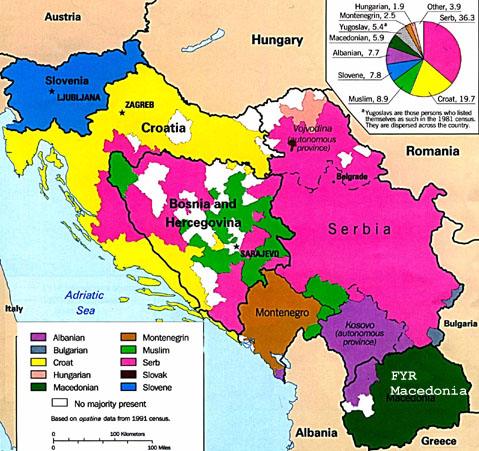 A map of former Yugoslavia from 1991 and the ethnicities within it prior to the conflicts. Note the especially mixed population in Bosnia.
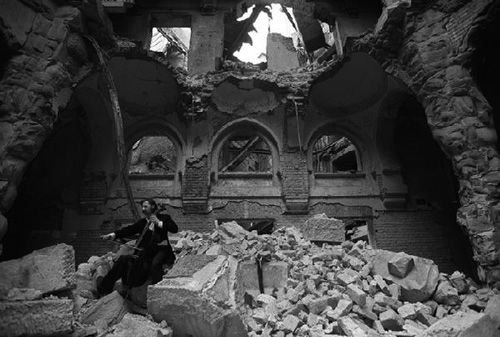 A building in Sarajevo lies in rubble after being attacked by Serb forces.
Refugees from Kosovo flee the borders, in search of a safer place to lay their heads.
 Serbian tank fire blows up a parliament building in Bosnia.
A sign in Sarajevo during the Yugoslavian civil war, warning citizens of Serbian snipers hiding nearby.

A grave site in Sarajevo in 1997, once a field where children played, is now a cemetery to hundreds of fallen victims of the Serbian attacks against the Bosnian capital.
Tuesday, June 5, 2007
Pictures To Help Explain Things Further

This picture shows the no stability or progress five years after the NATO intervention.
Reader Involvement:
I did a lot of research on the effects of the NATO stepping in, and I found out that them bringing war only did more destruction. What are your views on the matter?

Despite peace protests, the violence went on after the public called for powerful and immediate action by the international community to stop "ethnic cleansing".
Reader Involvement:
I researched many examples of peaceful protests and I found out that even though the international community said that they understood and were going to help, not much came to them. I can't figure out why, do you have any ideas?

The "ethnic cleansing" in Yugoslavia was mainly shown through vicious hatred, violence, sexually commited crimes and other forms of hate crimes. In this photo, a young Bosnian Muslim man is doused with water by two Serb police after being thrown out a window.
Reader Involvement:
Many of the ways that "ethinic cleaning" was being done were so horrible and morbid. Do you think I should post some pictures of these crimes, even though they are disturbing, so that you can get a better understanding of what was happening to ensure "ethnic cleansing"?

This picture is one of a Serb woman with her child in Kosovo during the summer of 1999. This is what is left of their once 11 member family. After the Serbs invaded their city, only these two escaped, thankful for their lives.
Reader Involvement:
Many family members who lost those who they loved claimed they wished they were one of the dead, so that they wouldn't have to live without their loved ones, or see the destruction that was done. Which side do you take? Would you rather live to know your family is all dead and to see all the destrustion with all the added horrors, or be one of the thousands who died?
Subscribe to:
Posts (Atom)